This site is for U.S. healthcare professionals only

Request a Rep

About MYQORZO™

How MYQORZO works

Mechanism of action

MYQORZO targets the underlying pathophysiology of oHCM1

oHCM CARDIAC SARCOMERE2

In oHCM, there is a change in sarcomeric proteins resulting in excess cardiac contractility3
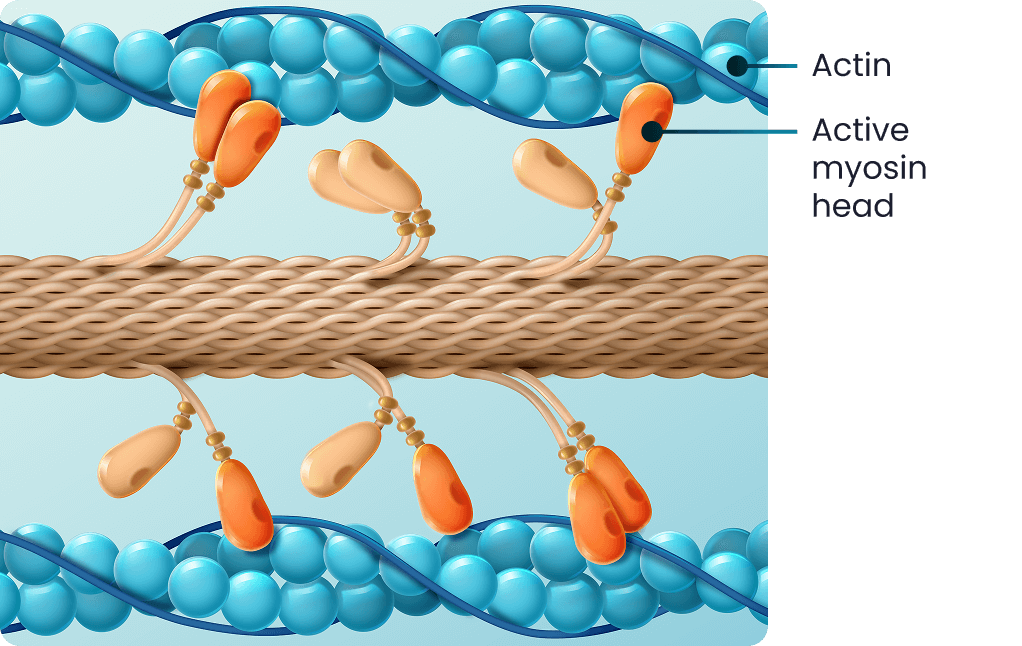
oHCM cardiac sarcomere
  • These changes result in increased actin and myosin cross-bridging in each cardiac cycle3
  • This leads to cardiac hypercontractility, impaired cardiac relaxation, and increased energy consumption3

With MYQORZO

oHCM CARDIAC SARCOMERE WITH MYQORZO1,4

MYQORZO reduces cardiac hypercontractility1
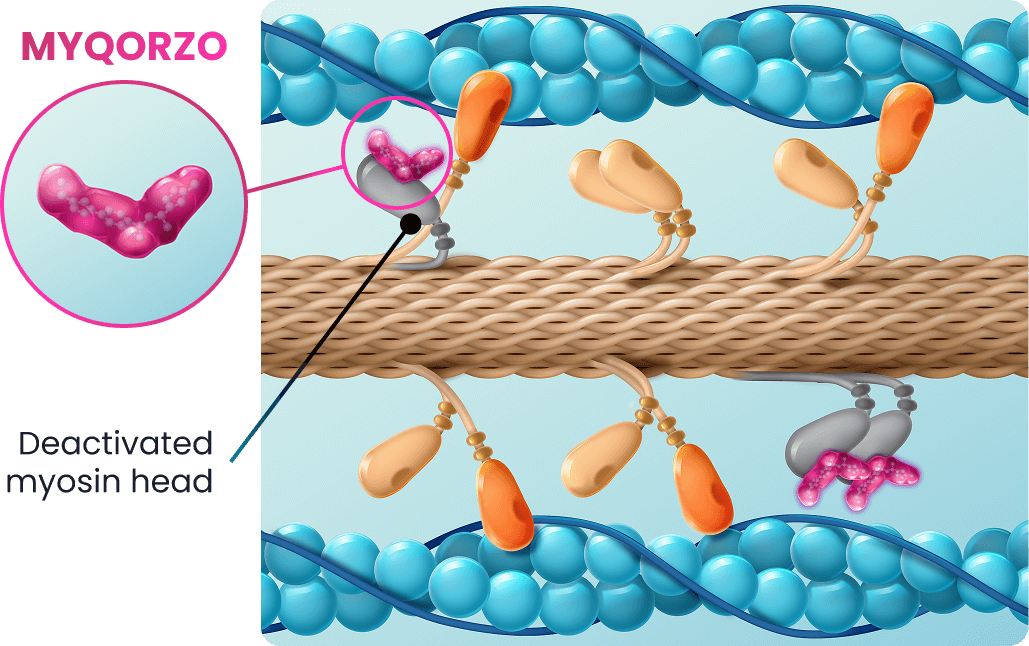
oHCM cardiac sarcomere with MYQORZO
  • Binds and inhibits cardiac myosin at a distinct binding site3
  • Reduces excessive myosin and actin cross-bridging resulting in3:
    • Decreased cardiac hypercontractility and reduced LVOT obstruction1

Clinical Pharmacology

MYQORZO was engineered for optimal pharmacology with quick onset of action and rapid reversibility1,3,5

Positive/negative icon

Low peak-to-trough variability helps mitigate the risk of overexposure or underexposure
Wide therapeutic window icon

Wide therapeutic window expands the safety margin

Approximately 3 days half-life icon

A half-life of 80 hours allows for rapid reversibility within 24 to 48 hours and the ability to reach steady state at ≈2 weeks (17 days)

Pill icon

Primarily metabolized by CYP2C9, to a lesser extent by CYP3A, CYP2D6, and CYP2C19

Review clinical trial results for MYQORZO

Learn more about treating your patients with MYQORZO

CYP=cytochrome; LVOT=left ventricular outflow tract; oHCM=obstructive hypertrophic cardiomyopathy.

References: 1. MYQORZO (aficamten). Prescribing information. Cytokinetics; 2025. 2. Garfinkel AC, Seidman JG, Seidman CE. Genetic pathogenesis of hypertrophic and dilated cardiomyopathy. Heart Fail Clin. 2018;14(2):139-146. doi:10.1016/j.hfc.2017.12.004 3. Hartman JJ, Hwee DT, Robert-Paganin J, et al. Aficamten is a small-molecule cardiac myosin inhibitor designed to treat hypertrophic cardiomyopathy. Nat Cardiovasc Res. 2024;3(8):1003-1016. doi:10.1038/s44161-024-00505-0 4. Cooper GM. Actin, myosin, and cell movement. In: The Cell: A Molecular Approach. 2nd ed. Sinauer Associates; 2000. 5. Coats CJ, Masri A, Nassif ME, et al. Dosing and safety profile of aficamten in symptomatic obstructive hypertrophic cardiomyopathy: results from SEQUOIA-HCM. J Am Heart Assoc. 2024;13(15):e035993. doi:10.1161/JAHA.124.035993

IMPORTANT SAFETY INFORMATION

WARNING: RISK OF HEART FAILURE

MYQORZO reduces left ventricular ejection fraction (LVEF) and can cause heart failure due to systolic dysfunction.

Echocardiogram assessments are required prior to and during treatment with MYQORZO to monitor for systolic dysfunction. Initiation of MYQORZO in patients with LVEF <55% is not recommended. Decrease the dose of MYQORZO if LVEF is <50% and ≥40%. Interrupt the dose of MYQORZO if LVEF <40% or if the patient experiences heart failure symptoms or worsening clinical status due to systolic dysfunction.

Because of the risk of heart failure due to systolic dysfunction, MYQORZO is available only through a restricted program under a Risk Evaluation and Mitigation Strategy (REMS) called the MYQORZO REMS Program.

CONTRAINDICATIONS

MYQORZO is contraindicated with concomitant use of rifampin.

WARNING AND PRECAUTIONS

Heart Failure
MYQORZO reduces cardiac contractility, which can reduce LVEF and cause heart failure.

Patients who experience a serious intercurrent illness (eg, serious infection) or arrhythmia (eg, new or uncontrolled atrial fibrillation) may be at greater risk of developing systolic dysfunction and heart failure.

Assess patients’ clinical status and LVEF prior to and during treatment and adjust the MYQORZO dose accordingly. New or worsening arrhythmia, dyspnea, chest pain, fatigue, leg edema, or elevations in N-terminal pro-B-type natriuretic peptide may be signs and symptoms of heart failure.

Initiation of MYQORZO in patients with LVEF <55% is not recommended.

MYQORZO REMS Program

MYQORZO is available only through a restricted program called the MYQORZO REMS Program, because of the risk of heart failure due to systolic dysfunction.

Notable requirements of the MYQORZO REMS Program include:

  • Prescribers must be certified by enrolling in the MYQORZO REMS Program
  • Patients must enroll in the MYQORZO REMS Program and comply with ongoing monitoring requirements
  • Pharmacies must be certified by enrolling in the MYQORZO REMS Program and must only dispense to patients who are authorized to receive MYQORZO
  • Wholesalers and distributors must only distribute to certified pharmacies

Further information is available at www.MYQORZOREMS.com, or at 1-844-285-7367.

Cytochrome P450 Interactions Leading to Heart Failure or Loss of Effectiveness
MYQORZO is metabolized primarily by CYP2C9, and to a lesser extent by CYP3A, CYP2D6, and CYP2C19 enzymes. Initiation of medications that inhibit multiple P450 pathways of MYQORZO elimination (eg, fluconazole, voriconazole, or fluvoxamine) or strong CYP2C9 inhibitors, and discontinuation of moderate-to-strong CYP3A inducers may lead to increased blood concentrations of aficamten and increase the risk of heart failure due to systolic dysfunction. Conversely, initiation of medications that induce P450 pathways of MYQORZO (eg, rifampin, moderate-to-strong CYP3A inducers) may lead to decreased blood concentrations of aficamten and potential loss of effectiveness. Assess LVEF 2 to 8 weeks after initiation of such inhibitors or after discontinuation of such inducers and adjust the dose of MYQORZO accordingly.

Advise patients of the potential for drug interactions. Advise patients to inform their healthcare provider of all concomitant medications prior to and during MYQORZO treatment.

ADVERSE REACTIONS

Hypertension (8% vs 2%) was the only adverse reaction occurring in >5% of patients and more commonly on MYQORZO than on placebo in the pivotal trial.

INDICATIONS AND USAGE

MYQORZO is indicated for the treatment of adults with symptomatic obstructive hypertrophic cardiomyopathy (oHCM) to improve functional capacity and symptoms.

Please see full Prescribing Information, including Boxed WARNING.