Treating oHCM
Are your patients with oHCM still symptomatic with first-line treatments?
Looking for disease state information you can share with your patients?
Learn more about symptomatic oHCMUnmet medical need
Beta blockers and calcium channel blockers are recommended as first-line treatments by the 2024 AHA/ACC/Multisociety* Guidelines1
In oHCM, these treatments:

May not completely address treatment goals2,3
- Partial symptom improvement or no response
- Inconsistent LVOT gradient reduction
- No improvement in exercise capacity

Have limited evidence2
- Guideline recommendations based on small, mostly nonrandomized studies with short follow-up

Do not address the underlying disease pathophysiology1
- Were not designed to reduce the underlying cardiac hypercontractility due to abnormalities in sarcomere function
Consider a treatment that addresses the underlying pathophysiology of oHCM1
START a CMI
CMIs are recommended by the 2024 AHA/ACC/Multisociety* Guidelines for patients with oHCM who need options beyond first-line treatments1
Cardiac myosin inhibitors (CMIs) are a Class I recommendation, FDA-approved treatment for obstructive hypertrophic cardiomyopathy (oHCM)1,4
For your adult patients with symptomatic oHCM, is it time to start a CMI?
Diagnosis and prevalence
What is HCM?
Hypertrophic cardiomyopathy (HCM) is defined as left ventricular hypertrophy in the absence of another identified cause of hypertrophy5
- It is most commonly caused by mutations in sarcomeric proteins5
- HCM can be progressive and is characterized by excessive cardiac contractility, impaired relaxation and reduced compliance during diastole, and excess energy consumption1,6,7
- The 2024 AHA/ACC/Multisociety* Guidelines consider HCM obstructive if LVOT gradient is ≥30 mmHg1

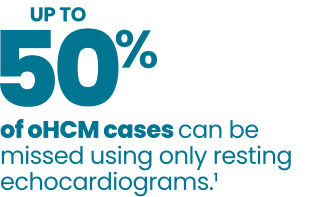
Obstruction may be present at rest or upon provocation using Valsalva maneuver, squat-to-stand tests, or stress echocardiogram1,5
DEFINITION OF HYPERTROPHY1
Presence of left ventricle wall thickness

≥15 mm
Adult patients
≥13 mm
Patients with a known positive genotype or family history of HCM
Detecting HCM1
Triggers for HCM evaluation may include:
- Family history of HCM
- Symptoms of HCM
- Cardiac event
- Heart murmur
- Echocardiography or ECG abnormalities
NONSPECIFIC SIGNS AND SYMPTOMS5,8-10
HCM can often be overlooked, as many signs and symptoms overlap with other conditions such as asthma, anxiety, mitral valve prolapse, and CAD.8

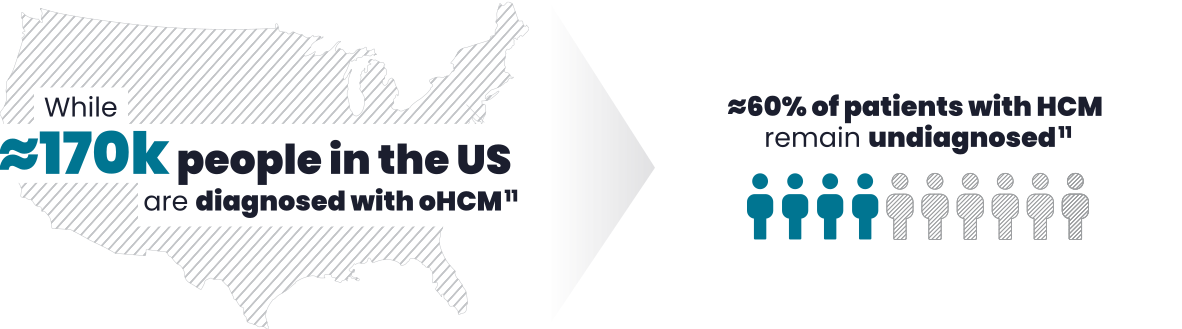
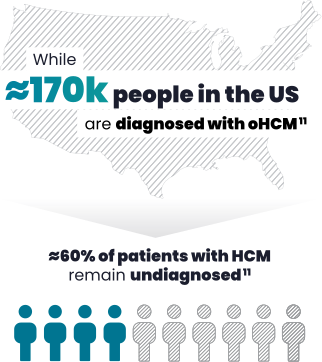
oHCM is underdiagnosed in the general population
*Multisociety includes American Medical Society for Sports Medicine, Heart Rhythm Society, Pediatric and Congenital Electrophysiology Society, and Society for Cardiovascular Magnetic Resonance.1
ACC=American College of Cardiology; AHA=American Heart Association; CAD=coronary artery disease; CMI=cardiac myosin inhibitor; ECG=electrocardiogram; LVOT=left ventricular outflow tract; oHCM=obstructive hypertrophic cardiomyopathy.
References: 1. Ommen SR, Ho CY, Asif IM, et al. 2024 AHA/ACC/AMSSM/HRS/PACES/SCMR guideline for the management of hypertrophic cardiomyopathy: a report of the American Heart Association/American College of Cardiology Joint Committee on Clinical Practice Guidelines. Circulation. 2024;149(23):e1239-e1311. doi:10.1161/cir.0000000000001250 2. Zhu M, Reyes KRL, Bilgili G, et al. Medical therapies to improve left ventricular outflow obstruction and diastolic function in hypertrophic cardiomyopathy. JACC Adv. 2023;2(8):100622. doi:10.1016/j.jacadv.2023.100622 3. Dybro AM, Rasmussen TB, Nielsen RR, Andersen MJ, Jensen MK, Poulsen SH. Randomized trial of metoprolol in patients with obstructive hypertrophic cardiomyopathy. J Am Coll Cardiol. 2021;78(25):2505-2517. doi:10.1016/j.jacc.2021.07.065 4. Turer AT, Wang A. Cardiac myosin inhibitors: unlocking potential to improve treatment in hypertrophic cardiomyopathy. Circulation. 2023;147(9):700-702. doi:10.1161/CIRCULATIONAHA.122.061015 5. Marian AJ, Braunwald E. Hypertrophic cardiomyopathy: genetics, pathogenesis, clinical manifestations, diagnosis, and therapy. Circ Res. 2017;121(7):749-770. doi:10.1161/CIRCRESAHA.117.311059 6. Garfinkel AC, Seidman JG, Seidman CE. Genetic pathogenesis of hypertrophic and dilated cardiomyopathy. Heart Fail Clin. 2018;14(2):139-146. doi:10.1016/j.hfc.2017.12.004 7. Basit H, Alahmadi MH, Rout P, Sharma S. Hypertrophic cardiomyopathy. Stat Pearls Publishing; 2024. 8. Argulian E, Sherrid MV, Messerli FH. Misconceptions and facts about hypertrophic cardiomyopathy. Am J Med. 2016;129(2):148-152. doi:10.1016/j.amjmed.2015.07.035 9. Maron BJ, Desai MY, Nishimura RA, et al. Diagnosis and evaluation of hypertrophic cardiomyopathy: JACC state-of-the-art review. J Am Coll Cardiol. 2022;79(4):372-389. doi:10.1016/j.jacc.2021.12.002 10. Zaiser E, Sehnert AJ, Duenas A, Saberi S, Brookes E, Reaney M. Patient experiences with hypertrophic cardiomyopathy: a conceptual model of symptoms and impacts on quality of life. J Patient Rep Outcomes. 2020;4(1):102. doi:10.1186/s41687-020-00269-8 11. Data on file. South San Francisco, CA. Cytokinetics Inc; 2025.