About oHCM
HCM can be progressive and is often overlooked1,2
Diagnosis and prevalence
What is HCM?
Hypertrophic cardiomyopathy (HCM) is defined as left ventricular hypertrophy in the absence of another identified cause of hypertrophy3
- It is most commonly caused by mutations in sarcomeric proteins3
- HCM can be progressive and is characterized by excessive cardiac contractility, impaired relaxation and reduced compliance during diastole, and excess energy consumption1,4,5
- The 2024 AHA/ACC/Multisociety* Guidelines consider HCM obstructive if LVOT gradient is ≥30 mmHg1

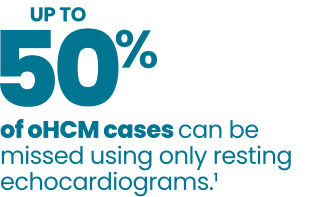
Obstruction may be present at rest or upon provocation using Valsalva maneuver, squat-to-stand tests, or stress echocardiogram1,3
DEFINITION OF HYPERTROPHY1
Presence of left ventricle wall thickness

≥15 mm
Adult patients
≥13 mm
Patients with a known positive genotype or family history of HCM
Detecting HCM1
Triggers for HCM evaluation may include:
- Family history of HCM
- Symptoms of HCM
- Cardiac event
- Heart murmur
- Echocardiography or ECG abnormalities
NONSPECIFIC SYMPTOMS2,3,6,7
HCM can often be overlooked, as many symptoms overlap with other conditions such as asthma, anxiety, mitral valve prolapse, and CAD.2

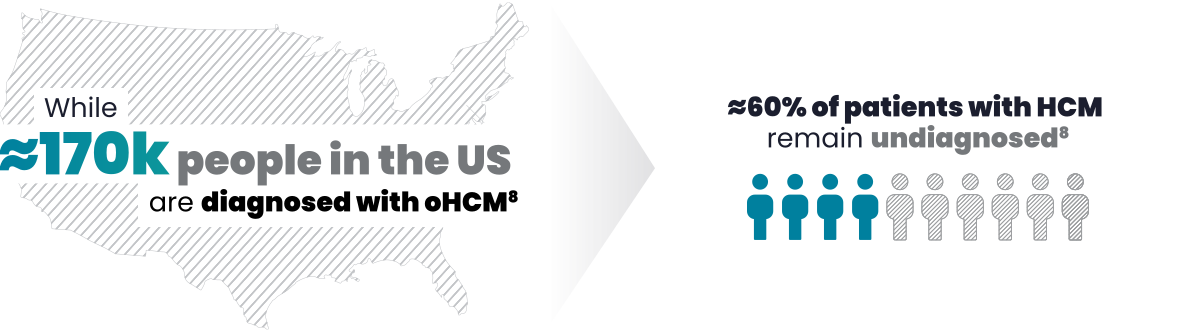
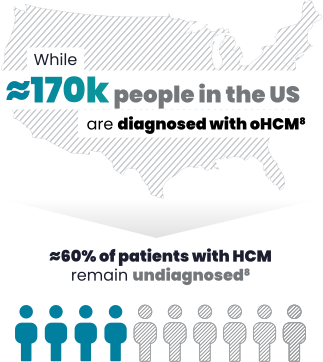
oHCM is underdiagnosed in the general population
Unmet medical need
Are your patients with oHCM still symptomatic with first-line treatments?
Beta blockers and calcium channel blockers are recommended as first-line treatments by the 2024 AHA/ACC Multisociety* Guidelines1
In oHCM, these treatments:

May not completely address treatment goals9,10
- Partial symptom improvement or no response
- Inconsistent LVOT gradient reduction
- No improvement in exercise capacity

Have limited evidence9
- Guideline recommendations based on small, nonrandomized studies with short follow-up

Do not address the underlying disease pathophysiology1
- Were not designed to reduce the underlying cardiac hypercontractility due to abnormalities in sarcomere function
Consider a treatment that addresses the underlying pathophysiology of oHCM1
START a CMI
CMIs are recommended by the 2024 AHA/ACC/Multisociety* Guidelines for patients with oHCM who need options beyond first-line treatments1
Cardiac myosin inhibitors (CMIs) are a Class I, FDA-approved treatment for oHCM1,11
For your adult patients with oHCM who remain symptomatic, is it time to start a CMI?
*Multisociety includes American Medical Society for Sports Medicine, Heart Rhythm Society, Pediatric and Congenital Electrophysiology Society, and Society for Cardiovascular Magnetic Resonance.1
ACC=American College of Cardiology; AHA=American Heart Association; CAD=coronary artery disease; CMI=cardiac myosin inhibitor; ECG=electrocardiogram; LVOT=left ventricular outflow tract; oHCM=obstructive hypertrophic cardiomyopathy.
References: 1. Ommen SR, Ho CY, Asif IM, et al. 2024 AHA/ACC/AMSSM/HRS/PACES/SCMR guideline for the management of hypertrophic cardiomyopathy: a report of the American Heart Association/American College of Cardiology Joint Committee on Clinical Practice Guidelines. Circulation. 2024;149(23):e1239-e1311. doi:10.1161/cir.0000000000001250. 2. Argulian E, Sherrid MV, Messerli FH. Misconceptions and facts about hypertrophic cardiomyopathy. Am J Med. 2016;129(2):148-152. doi:10.1016/j.amjmed.2015.07.035 3. Marian AJ, Braunwald E. Hypertrophic cardiomyopathy: genetics, pathogenesis, clinical manifestations, diagnosis, and therapy. Circ Res. 2017;121(7):749-770. doi:10.1161/CIRCRESAHA.117.311059 4. Garfinkel AC, Seidman JG, Seidman CE. Genetic pathogenesis of hypertrophic and dilated cardiomyopathy. Heart Fail Clin. 2018;14(2):139-146. doi:10.1016/j.hfc.2017.12.004 5. Basit H, Alahmadi MH, Rout P, Sharma S. Hypertrophic cardiomyopathy. Stat Pearls Publishing; 2024. 6. Maron BJ, Desai MY, Nishimura RA, et al. Diagnosis and evaluation of hypertrophic cardiomyopathy: JACC state-of-the-art review. J Am Coll Cardiol. 2022;79(4):372-389. doi:10.1016/j.jacc.2021.12.002 7. Zaiser E, Sehnert AJ, Duenas A, Saberi S, Brookes E, Reaney M. Patient experiences with hypertrophic cardiomyopathy: a conceptual model of symptoms and impacts on quality of life. J Patient Rep Outcomes. 2020;4(1):102. doi:10.1186/s41687-020-00269-8 8. Data on file. South San Francisco, CA. Cytokinetics Inc; 2025. 9. Zhu M, Reyes KRL, Bilgili G, et al. Medical therapies to improve left ventricular outflow obstruction and diastolic function in hypertrophic cardiomyopathy. JACC Adv. 2023;2(8):100622. doi:10.1016/j.jacadv.2023.100622 10. Dybro AM, Rasmussen TB, Nielsen RR, Andersen MJ, Jensen MK, Poulsen SH. Randomized trial of metoprolol in patients with obstructive hypertrophic cardiomyopathy. J Am Coll Cardiol. 2021;78(25):2505-2517. doi:10.1016/j.jacc.2021.07.065 11. Turer AT, Wang A. Cardiac myosin inhibitors: unlocking potential to improve treatment in hypertrophic cardiomyopathy. Circulation. 2023;147(9):700-702. doi:10.1161/CIRCULATIONAHA.122.061015