Clinical Trial Design
SEQUOIA-HCM: The largest-to-date Phase 3 clinical trial in oHCM1,2
CLINICAL TRIAL DESIGN
Evaluated efficacy and safety in a randomized, double-blind, placebo-controlled study over 24 weeks2
- Patients taking MYQORZO™ initiated treatment at 5 mg orally once daily and were titrated as needed using echocardiographic guidance by 5-mg increments to a maximum dose of 20 mg once daily based on patient response2*
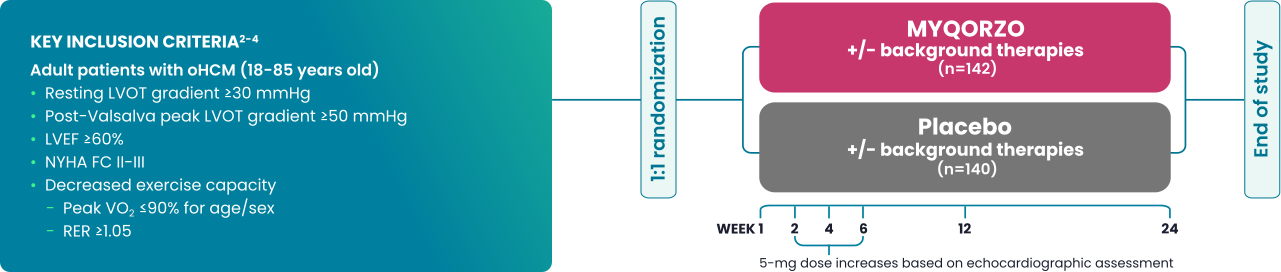
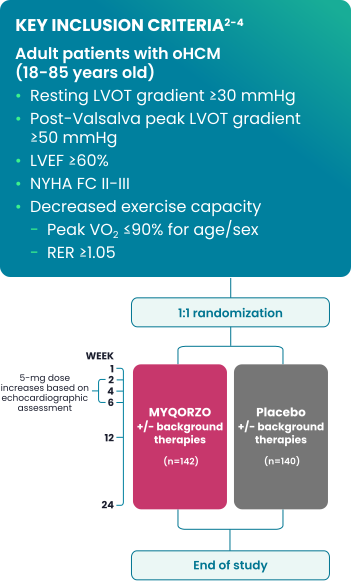

85% of patients with symptomatic oHCM enrolled in SEQUOIA-HCM were on ≥1 oHCM standard of care therapy (beta blockers, calcium channel blockers, and/or disopyramide)2†
ENDPOINTS
The SEQUOIA-HCM trial met all of its prespecified clinical endpoints1-3

PRIMARY ENDPOINT
P Value
Change in peak oxygen consumption (peak VO2) as assessed during cardiopulmonary exercise testing (baseline to Week 24)
P<0.0001

SECONDARY ENDPOINTS‡
P Value
Mean change in KCCQ-CSS (baseline to Week 24)
P<0.0001
Proportion of patients with ≥1 NYHA Class improvement (baseline to Week 24)
P<0.0001
Mean change in Valsalva LVOT gradient (baseline to Week 24)
P<0.0001
Proportion of patients with LVOT gradient post-Valsalva maneuver <30 mmHg (at Week 24)
P<0.0001
Mean duration of septal reduction therapy eligibility (during 24 weeks of treatment)§
P<0.0001
Mean change in KCCQ-CSS (baseline to Week 12)
P<0.0001
Proportion of patients with ≥1 NYHA Class improvement (baseline to Week 12)
P<0.0001
Mean change in Valsalva LVOT gradient (baseline to Week 12)
P<0.0001
Proportion of patients with LVOT gradient post-Valsalva maneuver <30 mmHg (at Week 12)
P<0.0001
Mean change in total workload as assessed during cardiopulmonary exercise testing (baseline to Week 24)
P<0.0001

SELECT EXPLORATORY AND ADDITIONAL ENDPOINTS EVALUATED
- Distribution of NYHA Functional Classes over time
- Mean change in left atrial volume index (LAVI) (baseline to Week 24)
- Mean change in LV maximal wall thickness (baseline to Week 24)
- Mean change in NT-proBNP (baseline to Week 24)
Inclusion and exclusion criteria in SEQUOIA-HCM
BASELINE PATIENT CHARACTERISTICS
The majority of patients enrolled in SEQUOIA-HCM were already being treated with standard of care oHCM treatment2
| Baseline characteristics2,5 | MYQORZO (n=142) | Placebo (n=140) |
|---|---|---|
| Age, mean (years) | 59.2 | 59.0 |
| Sex, female | 56 (39.4%) | 59 (42.1%) |
| Race | ||
| White | 108 (76.1%) | 115 (82.1%) |
| Asian | 29 (20.4%) | 25 (17.9%) |
| Black | 3 (2.1%) | 0 |
| Other | 2 (1.4%) | 0 |
| Geographic region | ||
| North America | 49 (34.5%) | 45 (32.1%) |
| China | 24 (16.9%) | 22 (15.7%) |
| Rest of the world | 69 (48.6%) | 73 (52.1%) |
| Medical history | ||
| Hypertension | 75 (52.8%) | 70 (50.0%) |
| Family history of HCM | 41 (28.9%) | 34 (24.3%) |
| Known HCM-causing gene mutation | 24 (16.9%) | 25 (17.9%) |
| Paroxysmal atrial fibrillation | 21 (14.8%) | 20 (14.3%) |
| CAD | 19 (13.4%) | 16 (11.4%) |
| Diabetes | 14 (9.9%) | 9 (6.4%) |
| Permanent atrial fibrillation | 2 (1.4%) | 1 (0.7%) |
 | ||
| Background HCM therapy | ||
| Beta blocker | 86 (60.6%) | 87 (62.1%) |
| Calcium channel blocker | 44 (31%) | 35 (25%) |
| Disopyramide | 16 (11.3%) | 20 (14.3%) |
| None | 19 (13.4%) | 22 (15.7%) |
| ICD | 22 (15.5%) | 17 (12.1%) |
| KCCQ-CSS, mean score | 76 | 74 |
 | ||
| NYHA FC | ||
| II | 108 (76.1%) | 106 (75.7%) |
| III | 34 (23.9%) | 33 (23.6%) |
| IV | 0 | 1 (0.7%) |
| NT-proBNP, median | 818.0 pg/mL | 691.5 pg/mL |
| High-sensitivity cardiac troponin I, median | 12.9 ng/L | 11.5 ng/L |
 | ||
| Echocardiographic variables, mean | ||
| LVOT gradient post-Valsalva maneuver | 82.9 mmHg | 83.3 mmHg |
| Resting LVOT gradient | 54.8 mmHg | 55.3 mmHg |
| LVEF | 74.8% | 74.8% |
| Maximal LV wall thickness | 20.7 mm | 21.0 mm |
 Background HCM therapy
 NYHA FC
 Echocardiographic variables, mean
Baseline characteristics were well balanced between the 2 treatment arms3
*A response was defined as a decrease in Valsalva LVOT gradient to <30 mmHg and maintained LVEF ≥55%.2
†Stabilized on background therapy for >6 weeks.3
‡The 10 prespecified secondary endpoints in the SEQUOIA-HCM trial were tested hierarchically in the order presented here (proceed only if P<0.05). However, data and presentations on subsequent pages based on these endpoints are not presented in hierarchical order.1,3
§Septal reduction therapy eligibility defined by NYHA FC III-IV and an LVOT gradient ≥50 mmHg (at rest or post-Valsalva maneuver).3
ALT=alanine aminotransferase; AST=aspartate aminotransferase; CAD=coronary artery disease; CPET=cardiopulmonary exercise test; ECG=electrocardiogram; eGFR=estimated glomerular filtration rate; FC=Functional Class; HCM=hypertrophic cardiomyopathy; ICD=implantable cardioverter-defibrillator; KCCQ-CSS=Kansas City Cardiomyopathy Questionnaire–Clinical Summary Score; LV=left ventricular; LVEF=left ventricular ejection fraction; LVOT=left ventricular outflow tract; MI=myocardial infarction; NT-proBNP=N-terminal pro–B-type natriuretic peptide; NYHA=New York Heart Association; oHCM=obstructive hypertrophic cardiomyopathy; RER=respiratory exchange ratio; TBL=total bilirubin; ULN=upper limit of normal; VO2=oxygen consumption.
References: 1. Coats CJ, Maron MS, Abraham TP, et al. Exercise capacity in patients with obstructive hypertrophic cardiomyopathy: SEQUOIA-HCM baseline characteristics and study design. JACC Heart Fail. 2024;12(1):199-215. doi:10.1016/j.jchf.2023.10.004 2. MYQORZO (aficamten). Prescribing information. Cytokinetics; 2025. 3. Maron MS, Masri A, Nassif ME, et al. Aficamten for symptomatic obstructive hypertrophic cardiomyopathy. N Engl J Med. 2024;390(20):1849-1861. doi:10.1056/NEJMoa2401424 4. Supplement to: Maron MS, Masri A, Nassif ME, et al. Aficamten for symptomatic obstructive hypertrophic cardiomyopathy. N Engl J Med. 2024;390(20):1849-1861. doi:l0.1056/NEJMoa2401424 5. Data on file. South San Francisco, CA. Cytokinetics, Inc; 2024.