This site is for U.S. healthcare professionals only

Request a Rep

Efficacy

MYQORZO™: Statistically significant improvements across all prespecified endpoints1,2

PRIMARY ENDPOINT

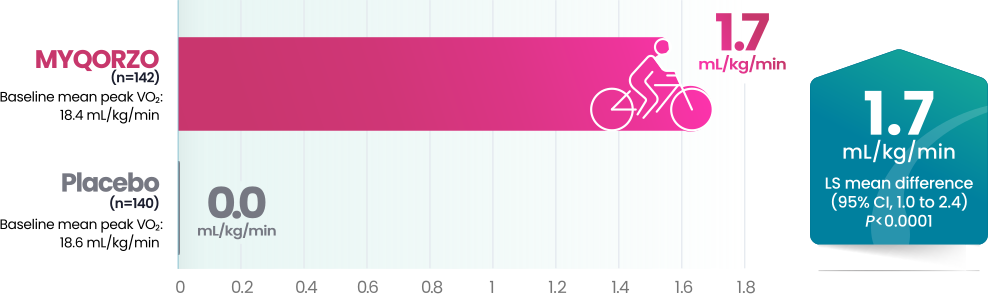
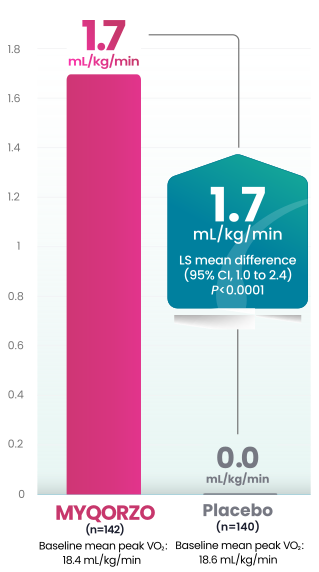
Significant improvement in exercise capacity (peak VO2)1

Change in peak VO2, as measured by CPET at Week 241

MYQORZO(TM) change in peak VO2 vs placebo as measured by CPET at Week 24

Change from baseline in peak VO2, LS mean (mL/kg/min)

Number needed to treat to achieve peak VO2 improvement3: 3.8

Person walking on treadmill icon

Peak VO2 is an objective and reproducible measure of functional capacity4

Peak VO2 improvement was associated with improvements in3

NYHA Functional ClassResting and Valsalva LVOT gradientsKCCQ-CSS score

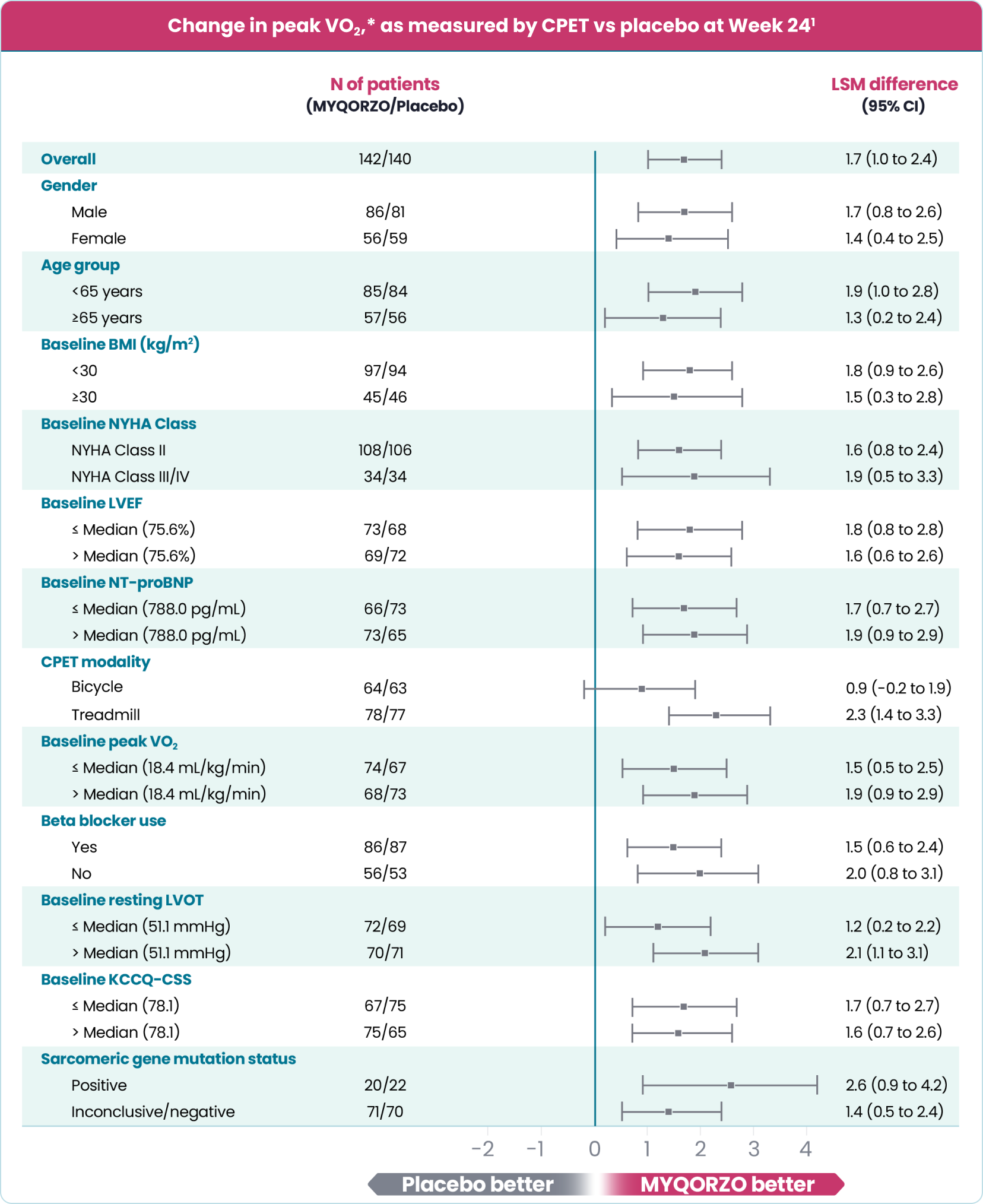
Primary endpoint subgroup analysis

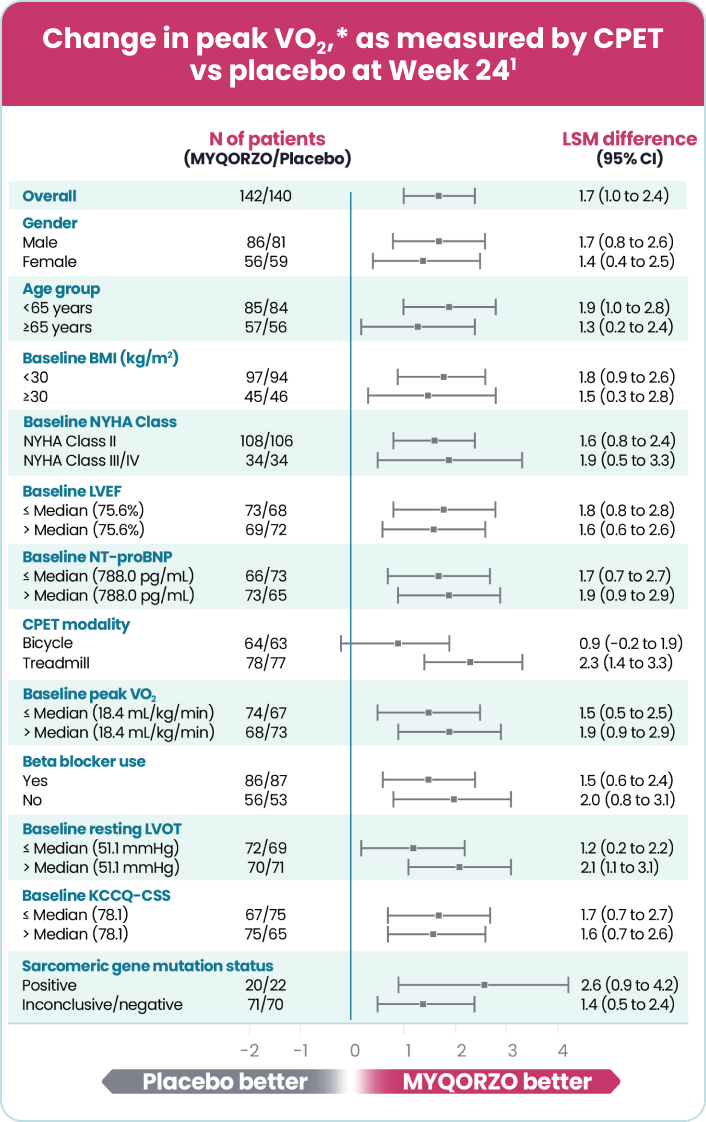
Consistent treatment effect on exercise capacity (peak VO2) observed across a broad range of demographic and clinical variables1

MYQORZO primary endpoint subgroup analysis

*This figure presents effects in various subgroups, all of which are baseline characteristics. The 95% confidence limits that are shown do not take into account the number of comparisons made and may not reflect the effect of a particular factor after adjustment for all other factors. Apparent homogeneity or heterogeneity among groups should not be over-interpreted.1

SECONDARY AND ADDITIONAL ENDPOINTS

MYQORZO: Demonstrated efficacy across clinical outcomes1

At 24 weeks of treatment

MYQORZO: Showed rapid and sustained symptom improvement1

SECONDARY ENDPOINT

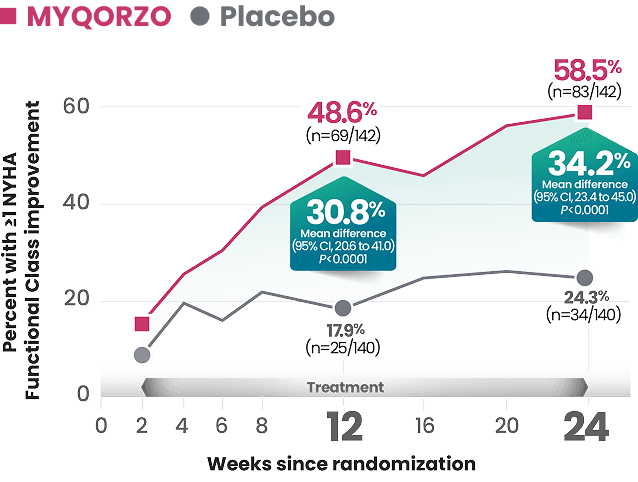
Proportion of patients with ≥1 class improvement in NYHA Functional Class1,5

Proportion of patients greater than or equal to one class improvement in NYHA Functional Class with MYQORZO(TM) aficatem vs placebo

Separation vs placebo was observed as early as Week 6, with statistical significance at Weeks 12 and 241,5

Missing data from Weeks 12, 24, and intermittent missing data were imputed per the statistical analysis plan and were summarized based on the imputed value and therefore were not counted in the missing category. Percentages were based on the number of participants in the analysis set for summary up to Week 24.5

The 10 prespecified secondary endpoints in the SEQUOIA-HCM trial were tested hierarchically (proceed only if P<0.05). However, data are not presented in hierarchical order. Please refer to the clinical endpoints to review the order in which they were evaluated.2,4

Exploratory Endpoints

Explore safety data for MYQORZO

Learn more about treating your patients with MYQORZO

BMI=body mass index; CI=confidence interval; CMH=Cochran–Mantel–Haenszel; CPET=cardiopulmonary exercise test; HCM=hypertrophic cardiomyopathy; KCCQ-CSS=Kansas City Cardiomyopathy Questionnaire—Clinical Summary Score; LS=least squares; LSM=least squares mean; LV=left ventricular; LVEF=left ventricular ejection fraction; LVOT=left ventricular outflow tract; MAR=missing at random; MCMC=Markov chain Monte Carlo; NT-proBNP=N-terminal pro–B-type natriuretic peptide; NYHA=New York Heart Association; oHCM=obstructive hypertrophic cardiomyopathy; VO2=oxygen consumption.

References: 1. MYQORZO (aficamten). Prescribing information. Cytokinetics; 2025. 2. Maron MS, Masri A, Nassif ME, et al. Aficamten for symptomatic obstructive hypertrophic cardiomyopathy. N Engl J Med. 2024;390(20):1849-1861. doi:10.1056/NEJMoa2401424 3. Lee MMY, Masri A, Nassif ME, et al. Aficamten and cardiopulmonary exercise test performance: a substudy of the SEQUOIA-HCM randomized clinical trial. JAMA Cardiol. 2024;9(11):990-1000. doi:10.1001/jamacardio.2024.2781 4. Coats CJ, Maron MS, Abraham TP, et al. Exercise capacity in patients with obstructive hypertrophic cardiomyopathy: SEQUOIA-HCM baseline characteristics and study design. JACC Heart Fail. 2024;12(1):199-215. doi:10.1016/j.jchf.2023.10.004 5. Data on file. South San Francisco, CA. Cytokinetics, Inc; 2024. 6. Ommen SR, Ho CY, Asif IM, et al. 2024 AHA/ACC/AMSSM/HRS/PACES/SCMR guideline for the management of hypertrophic cardiomyopathy: a report of the American Heart Association/American College of Cardiology Joint Committee on Clinical Practice Guidelines. Circulation. 2024;149(23):e1239-e1311. doi:10.1161/cir.0000000000001250 7. Green CP, Porter CB, Bresnahan DR, Spertus JA. Development and evaluation of the Kansas City Cardiomyopathy Questionnaire: a new health status measure for heart failure. J Am Coll Cardiol. 2000;35(5):1245-1255. doi:10.1016/s0735-1097(00)00531-3 8. Spertus JA, Jones PG, Sandhu AT, Arnold SV. Interpreting the Kansas City Cardiomyopathy Questionnaire in clinical trials and clinical care: JACC state-of-the-art review. J Am Coll Cardiol. 2020;76(20):2379-2390. doi:10.1016/j.jacc.2020.09.542 9. Nassif M, Fine JT, Dolan C, et al. Validation of the Kansas City Cardiomyopathy Questionnaire in symptomatic obstructive hypertrophic cardiomyopathy. JACC Heart Fail. 2022;10(8):531-539. doi:10.1016/j.jchf.2022.03.002 10. Daniels LB, Maisel AS. Natriuretic peptides. J Am Coll Cardiol. 2007;50(25):2357-2368. doi:10.1016/j.jacc.2007.09.021. 11. Suzuki S, Sugiyama S. The molar ratio of N-terminal pro-B-type natriuretic peptide/B-type natriuretic peptide for heart failure-related events in stable outpatients with cardiovascular risk factors. Intern Med. 2018;57(18):2621-2630. doi:10.2169/internalmedicine.0471-17

IMPORTANT SAFETY INFORMATION

WARNING: RISK OF HEART FAILURE

MYQORZO reduces left ventricular ejection fraction (LVEF) and can cause heart failure due to systolic dysfunction.

Echocardiogram assessments are required prior to and during treatment with MYQORZO to monitor for systolic dysfunction. Initiation of MYQORZO in patients with LVEF <55% is not recommended. Decrease the dose of MYQORZO if LVEF is <50% and ≥40%. Interrupt the dose of MYQORZO if LVEF <40% or if the patient experiences heart failure symptoms or worsening clinical status due to systolic dysfunction.

Because of the risk of heart failure due to systolic dysfunction, MYQORZO is available only through a restricted program under a Risk Evaluation and Mitigation Strategy (REMS) called the MYQORZO REMS Program.

CONTRAINDICATIONS

MYQORZO is contraindicated with concomitant use of rifampin.

WARNING AND PRECAUTIONS

Heart Failure
MYQORZO reduces cardiac contractility, which can reduce LVEF and cause heart failure.

Patients who experience a serious intercurrent illness (eg, serious infection) or arrhythmia (eg, new or uncontrolled atrial fibrillation) may be at greater risk of developing systolic dysfunction and heart failure.

Assess patients’ clinical status and LVEF prior to and during treatment and adjust the MYQORZO dose accordingly. New or worsening arrhythmia, dyspnea, chest pain, fatigue, leg edema, or elevations in N-terminal pro-B-type natriuretic peptide may be signs and symptoms of heart failure.

Initiation of MYQORZO in patients with LVEF <55% is not recommended.

MYQORZO REMS Program

MYQORZO is available only through a restricted program called the MYQORZO REMS Program, because of the risk of heart failure due to systolic dysfunction.

Notable requirements of the MYQORZO REMS Program include:

  • Prescribers must be certified by enrolling in the MYQORZO REMS Program
  • Patients must enroll in the MYQORZO REMS Program and comply with ongoing monitoring requirements
  • Pharmacies must be certified by enrolling in the MYQORZO REMS Program and must only dispense to patients who are authorized to receive MYQORZO
  • Wholesalers and distributors must only distribute to certified pharmacies

Further information is available at www.MYQORZOREMS.com, or at 1-844-285-7367.

Cytochrome P450 Interactions Leading to Heart Failure or Loss of Effectiveness
MYQORZO is metabolized primarily by CYP2C9, and to a lesser extent by CYP3A, CYP2D6, and CYP2C19 enzymes. Initiation of medications that inhibit multiple P450 pathways of MYQORZO elimination (eg, fluconazole, voriconazole, or fluvoxamine) or strong CYP2C9 inhibitors, and discontinuation of moderate-to-strong CYP3A inducers may lead to increased blood concentrations of aficamten and increase the risk of heart failure due to systolic dysfunction. Conversely, initiation of medications that induce P450 pathways of MYQORZO (eg, rifampin, moderate-to-strong CYP3A inducers) may lead to decreased blood concentrations of aficamten and potential loss of effectiveness. Assess LVEF 2 to 8 weeks after initiation of such inhibitors or after discontinuation of such inducers and adjust the dose of MYQORZO accordingly.

Advise patients of the potential for drug interactions. Advise patients to inform their healthcare provider of all concomitant medications prior to and during MYQORZO treatment.

ADVERSE REACTIONS

Hypertension (8% vs 2%) was the only adverse reaction occurring in >5% of patients and more commonly on MYQORZO than on placebo in the pivotal trial.

INDICATIONS AND USAGE

MYQORZO is indicated for the treatment of adults with symptomatic obstructive hypertrophic cardiomyopathy (oHCM) to improve functional capacity and symptoms.
Please see full Prescribing Information, including Boxed WARNING.