Dosing, Titration, and Monitoring
Flexibility to rapidly titrate as early as 2 weeks and reach maintenance dose within 8 weeks1
INDIVIDUALIZED DOSING
Dosing is individualized based on the patient’s LVEF and LVOT gradient1
- Recommended starting dose: 5 mg once daily
- Echocardiogram performed 2 to 8 weeks after initiation of treatment or dose adjustment due to LVEF and LVOT gradient or drug interaction
- After a treatment interruption due to low LVEF, resume treatment, no earlier than 7 days, when LVEF ≥55% and re-initiate dose titration at the starting dose of 5 mg
- Increase dose every 2 to 8 weeks by 5 mg until 20 mg once daily or maintenance dose is achieved
- Maintenance monitoring: Echocardiogram every 6 months for patients with LVEF ≥55%
- Every 3 months if LVEF is <55% and ≥50%
- MYQORZO should be taken once daily with or without meals at about the same time every day. Swallow tablets whole
- If a dose is missed, it should be taken as soon as possible on the same day. The next scheduled dose should be taken at the usual time the following day. Two doses of MYQORZO should not be taken on the same day
| MYQORZO™ titration and dose adjustment | ||
|---|---|---|
| LVEF | Valsalva LVOT gradient | Dose adjustment |
| ≥55% | ≥30 mmHg | Increase dose by 5 mg (up to the maximum dose of 20 mg once daily) |
| ≥55% | <30 mmHg | Maintain dose |
| <55% and ≥50% | Any | Maintain dose |
| <50% and ≥40% | Any | Decrease dose by 5 mg* If already on 5 mg, interrupt treatment for at least 7 days |
| <40% | Any | Interrupt treatment for at least 7 days |
Consider enhanced monitoring for patients with intercurrent illness (eg, severe infection or COVID-19), new arrhythmia, or any other condition that may impair systolic function.†
*Decrease dose as follows: 20 mg to 15 mg, 15 mg to 10 mg, and 10 mg to 5 mg.1
†Do not increase dose until intercurrent illness or new arrhythmia has resolved or stabilized.1
MYQORZO is available in
4 dosage strengths1:
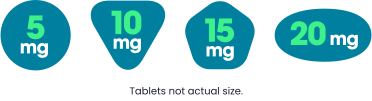
MYQORZO is only available through the MYQORZO Risk Evaluation and Mitigation Strategy (REMS) Program to mitigate the risk of heart failure due to systolic dysfunction.1 Visit MYQORZOREMS.com to learn more about treating your patients with MYQORZO.
Know the steps for determining the individualized dose of MYQORZO for your patients1
- Perform a baseline echocardiogram and initiate with the recommended starting dose (5 mg).
- Conduct an echocardiogram 2 to 8 weeks after initiation of treatment or dose adjustment due to LVEF and LVOT gradient or drug interaction. After a treatment interruption due to low LVEF, resume treatment, no earlier than 7 days, when LVEF ≥55% and re-initiate dose titration at the starting dose of 5 mg.
- Based on the echocardiogram results, enter your patient's LVEF and Valsalva LVOT gradient in the calculator to find out the dose adjustment that is needed.
Interactive Dosing & Titration Tool
Support your treatment plan with the Dosing & Titration Tool
Is your patient taking MYQORZO?
- Initiation or up-titration in patients with LVEF <55% is not recommended1
- Consider monitoring LVEF and adjust the dose, as needed, in patients with an intercurrent illness, new arrhythmia, or any other conditions that may impair systolic function. Do not increase the dose until the intercurrent illness or new arrhythmia has resolved or stabilized1
- Please review the dosing modifications for patients receiving inhibitors of multiple CYPs, strong CYP2C9 inhibitors, and moderate-to-strong CYP3A inducers
DOSING MODIFICATIONS
Dosing recommendations with specific drug-drug interactions1
- Concomitant use with rifampin is contraindicated
- Initiate MYQORZO at the recommended starting dose of 5 mg once daily in patients who are on stable therapy with fluconazole, voriconazole, fluvoxamine, strong CYP2C9 inhibitors, or in patients discontinuing a moderate to strong CYP3A inducer
Dose adjustments for patients taking stable doses of MYQORZO
| Concomitant drug | MYQORZO dose |
|---|---|
| Inhibitors of multiple CYPs or strong CYP2C9 inhibitors | |
| Patients intending to initiate fluvoxamine or a strong CYP2C9 inhibitor | Reduce dose from 20 mg to 10 mg, 15 mg to 5 mg, 10 mg to 5 mg Maintain 5 mg dose if currently receiving 5 mg |
| Patients intending to initiate fluconazole (>3 days) or voriconazole | If currently receiving 15 mg or 20 mg, reduce dose to 5 mg If currently receiving 5 mg or 10 mg, avoid concomitant use |
| Moderate-to-strong CYP3A inducers | |
| Patients intending to discontinue a moderate-to-strong CYP3A inducer | Reduce dose from 20 mg to 10 mg, 15 mg to 5 mg, 10 mg to 5 mg Maintain 5 mg dose if currently receiving 5 mg |
Assess LVEF and LVOT gradient 2 to 8 weeks following initiation or discontinuation of the above concomitant medications and titrate dose of MYQORZO accordingly.
COVID-19=coronavirus disease 2019; CYP=cytochrome; LVEF=left ventricular ejection fraction; LVOT=left ventricular outflow tract.
Reference: 1. MYQORZO (aficamten). Prescribing information. Cytokinetics; 2025.